

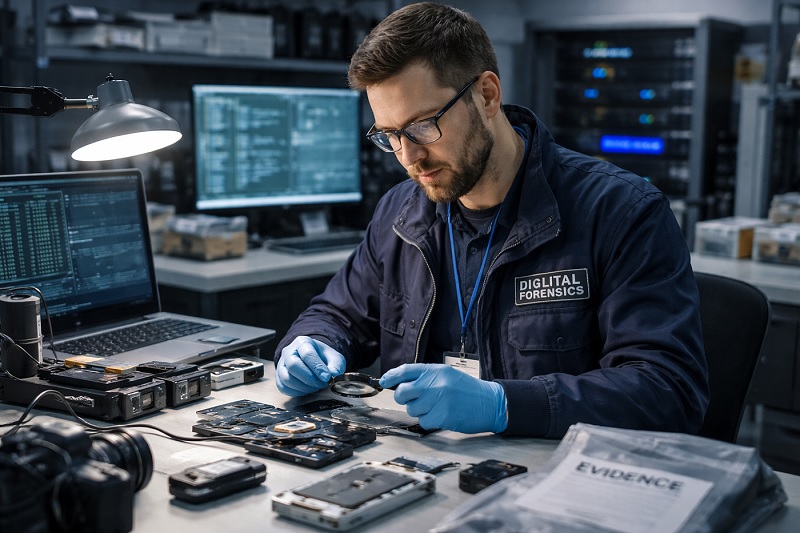
The modern crime scene is entirely invisible to the naked eye. When a sophisticated cyberattack breaches an enterprise network, there is no yellow tape, no shattered glass, and no physical footprint left behind. The intruders are phantoms, operating across global server nodes, manipulating code, and exfiltrating proprietary data in absolute silence. In the immediate aftermath of a breach, organizations are often left in a state of paralyzing uncertainty, aware that their defenses have failed but completely blind to the scope of the damage.
This is where digital forensics technology transitions from a niche technical discipline into a critical operational necessity. Digital forensics is the rigorous scientific process of identifying, preserving, analyzing, and presenting digital evidence. Far beyond simply rebooting compromised servers or restoring backups, modern forensic technology allows investigators to reconstruct the exact narrative of an attack, turning invisible digital chaos into an actionable, legally defensible timeline of events.
The Shift from Reactive Recovery to Proactive Deconstruction
Historically, the primary goal following a cyber incident was simply getting systems back online. IT departments would wipe infected machines, reinstall operating systems, and load the most recent data backups. While this achieved immediate operational recovery, it fundamentally destroyed the digital crime scene. By wiping the compromised machines, organizations inadvertently erased the very forensic artifacts that could explain how the attackers breached the perimeter, what specific data they stole, and whether they left hidden backdoors to strike again.
Modern cyber investigations rely on a radically different methodology. Before a compromised system is ever remediated, digital forensics teams employ specialized technology to freeze the environment. The objective is to deconstruct the attacker’s methodology down to the individual keystroke, identifying the initial vector of compromise, tracking the lateral movement across the network, and determining the exact volume of exfiltrated data.
Cryptographic Preservation and the Chain of Custody
The absolute bedrock of any cyber investigation is the preservation of evidence. If digital artifacts are altered—even accidentally by an IT administrator trying to assess the damage—the evidence immediately loses its integrity and becomes useless in a court of law or regulatory hearing.
To prevent this, forensic investigators utilize hardware write-blockers and specialized imaging software. These tools create a bit-for-bit, exact clone of a compromised hard drive without altering a single byte of the original data. Once the forensic image is captured, the technology generates a unique cryptographic hash—essentially a digital fingerprint—of the file. This cryptographic validation ensures a flawless chain of custody, proving to legal authorities, stakeholders, and insurance providers that the analyzed evidence is an identical, untampered reflection of the compromised system.
Extracting Hidden and Erased Artifacts
Threat actors go to great lengths to cover their tracks. They routinely clear event logs, delete malicious executables, and utilize anti-forensic software to overwrite deleted data. However, operating systems are incredibly complex and inherently “noisy,” quietly recording background activities in ways that are exceptionally difficult for an attacker to completely scrub.
Forensic extraction software allows investigators to dive deep beneath the visible file system. They parse through hidden registry hives, unallocated disk space, and shadow copies to recover deleted files and reverse-engineer the attacker’s movements. Even if an attacker deletes a malicious script, the forensic software can often find a residual artifact—such as a prefetch file or a thumbnail cache—that proves the executable was run on that specific machine at a highly specific time.
Unmasking Advanced Threats Through Volatile Memory Analysis
One of the most significant evolutions in modern cybercrime is the rise of fileless malware. Traditional malware writes an executable file to the victim’s hard drive, which can be easily detected by standard antivirus software and later recovered by forensic imaging. Fileless malware, however, operates entirely within the volatile memory, or RAM, of a compromised computer. It injects malicious code directly into legitimate, running system processes. If the computer is powered down or rebooted, the RAM is cleared, and the evidence completely vanishes.
To combat this, investigators now rely heavily on memory forensics. Using specialized live-response technology, responders can capture the entire contents of a machine’s volatile memory while the system is still running. Memory analysis tools dissect this chaotic dump of data, allowing investigators to see active network connections, extract decrypted passwords that were temporarily resting in memory, and isolate the exact malicious code fragments injected into otherwise trusted applications. Memory forensics is often the only technological method capable of proving the existence of a highly sophisticated, state-sponsored Advanced Persistent Threat (APT).
Reconstructing the Exfiltration Path via Network Forensics
While endpoint forensics focuses on the compromised computers themselves, network forensics focuses on the data traveling between them. When a threat actor infiltrates an enterprise, they rarely stay on a single machine. They move laterally, hopping from a compromised workstation to an active directory server, and ultimately to the database housing sensitive customer information. Eventually, they must package that data and send it out of the network to a server they control.
Network forensic technology captures and analyzes this digital transit. By examining firewall logs, NetFlow data, and deep packet captures, investigators can reconstruct the attacker’s communication pathways. Network packet analysis acts as the security camera of the digital enterprise. It reveals exactly which internal systems talked to the malicious external command-and-control servers, how the attackers disguised the stolen data to bypass security filters, and the precise geographic location where the proprietary information was sent.
Accelerating the Search for Truth with Automation
The primary challenge in modern cyber investigations is no longer a lack of evidence, but an overwhelming abundance of it. A mid-sized enterprise generates billions of discrete log events every single week. When a breach is discovered, tasking a human investigator with manually reading through millions of lines of code to find the exact moment an attacker escalated their administrative privileges is not just inefficient; it is mathematically impossible.
To solve the scale problem, modern forensic platforms heavily integrate automation and behavioral analytics. Instead of manually parsing logs, investigators deploy automated triage scripts that can simultaneously pull critical forensic artifacts from thousands of corporate endpoints in a matter of minutes.
Once the data is aggregated into a centralized lake, analytical software establishes a baseline of normal network behavior and automatically flags the anomalies. It can instantly highlight that a user account belonging to a finance executive mysteriously logged into a secure engineering server at three in the morning from an IP address located in a foreign country. By automating the data processing phase, forensic technology allows human analysts to focus entirely on contextualizing the attack and designing the containment strategy.
The Legal and Regulatory Imperative of Forensic Accuracy
The stakes of a cyber breach extend far beyond the server room. When customer data is stolen, intellectual property is compromised, or business operations are halted by ransomware, the fallout immediately shifts into the legal and regulatory arenas. Companies are bound by strict data privacy laws and industry-specific compliance mandates that require them to disclose exactly what data was compromised and who was affected.
Guesswork is legally indefensible. If an organization cannot definitively prove the boundaries of a data breach, regulators will often assume a worst-case scenario, leading to catastrophic fines and profound reputational damage. Digital forensics provides the empirical, technical truth required to navigate this legal minefield. It empowers corporate counsel to confidently report the exact scope of the incident, defend the company against civil litigation, and provide actionable intelligence to international law enforcement agencies pursuing the criminal syndicates responsible.
Ultimately, the deployment of advanced digital forensics technology changes the fundamental posture of an organization following a breach. It transitions a business from a state of blind victimization into a state of empowered clarity. By systematically unpacking the methodologies of digital adversaries, forensics does not just answer the question of what happened yesterday; it provides the architectural blueprint required to fortify the enterprise against the inevitable attacks of tomorrow.
